


Nonviolence Versus Capitalism
by Brian Martin
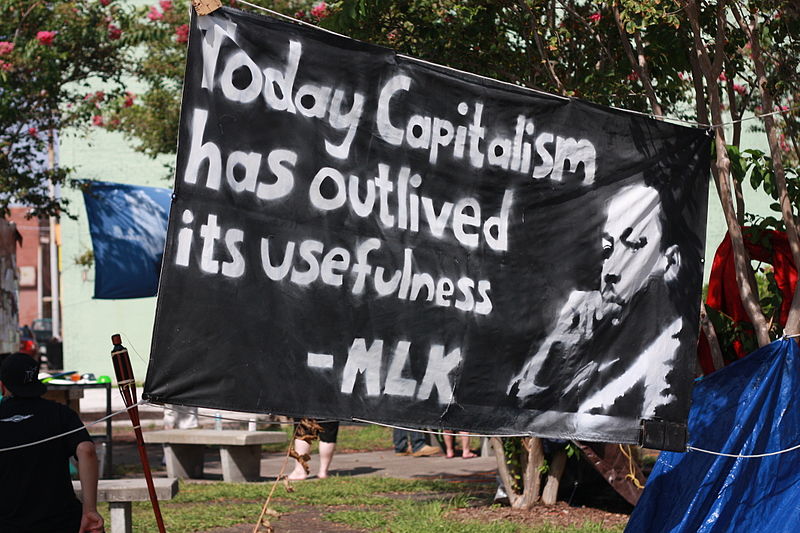
Martin Luther King banner at 2012 U.S. Republican Convention, courtesy commons.wikimedia.org
Nonviolent action provides the best hope for moving beyond capitalism to a more humane social and economic system. In the past, methods of nonviolent action such as strikes, boycotts, non-cooperation, sit-ins and alternative institutions have most commonly been used to challenge systems of direct violence, such as repressive governments. Capitalism is a more difficult system to challenge using nonviolent action because of the way it infiltrates people’s everyday thinking and behaviour. In order to develop a nonviolence strategy against capitalism, a careful analysis is required to pinpoint key areas for attention, spell out alternatives and highlight opportunities. At the core of capitalism is private ownership of the means of production, including land, factories and knowledge. This is backed up, ultimately, by the coercive power of the state. Problems with capitalism are well known, so only a summary is given here. Generally speaking, the system of ownership encourages individuals and groups to put special interests above general interests.
